


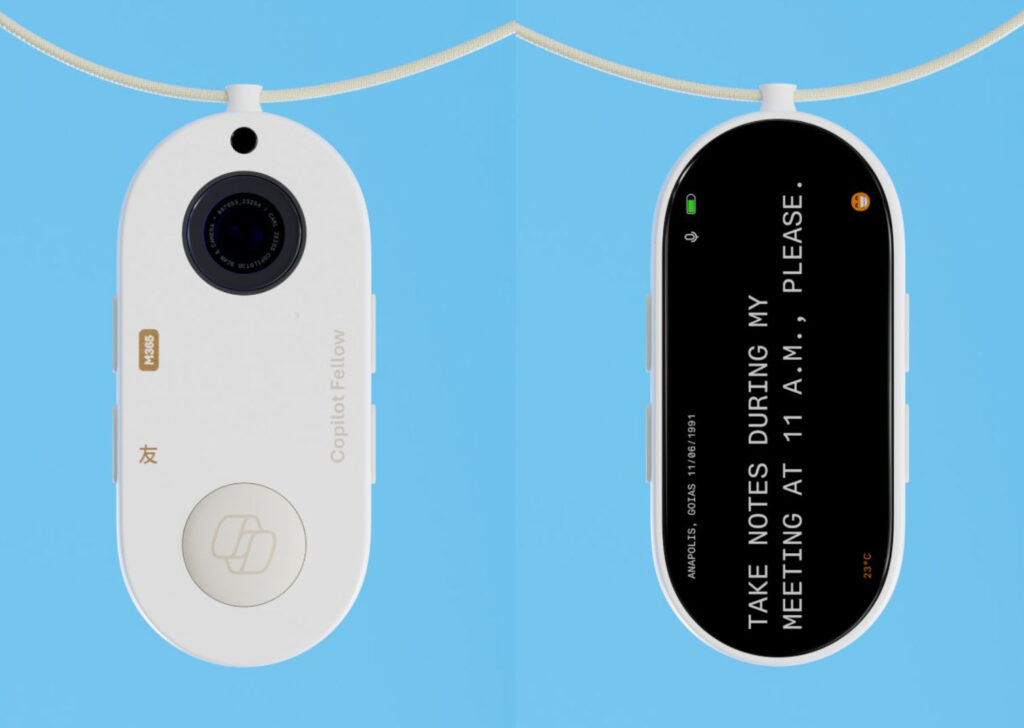
In an era where artificial intelligence lives mostly behind cold glass—trapped in smartphones, buried in taskbars, or tucked away in app drawers—the Copilot Fellow concept dares to make AI visible and wearable. Dreamed up by designer Braz de Pina, this concept pendant isn’t just another gadget; it’s an industrial design study in intimacy, immediacy, and intent.
Visually, the Copilot Fellow strikes a delicate balance between minimalism and character. Shaped like a polished pebble—smooth, pill-like, and symmetrical—it takes cues from personal artifacts rather than consumer electronics. There’s a deliberate softness to the object, as if it were designed to be held or fidgeted with, not just looked at.

The front face hosts a bold Copilot button, placed dead center like the pupil of a digital eye. Next to it, a tiny embedded camera suggests visual awareness, but it’s small enough not to feel invasive. On either side of the pendant are four shortcut buttons (two on each edge), giving the object a tactile, almost toy-like usability. It invites muscle memory the way your favorite analog devices used to—think of the Walkman or the original iPod click wheel.

What truly sets Copilot Fellow apart, however, is its dual-surface design philosophy. The front is intentionally distraction-free. It’s for action—press, speak, move on. But flip the device, and you’ll find a discreet rear screen. It’s not there to flood you with notifications but to serve as a quiet reference space. Think quick calendar glances, contextual answers, or transcription of your voice commands. This UI separation—action on the front, information on the back—is a clever rethinking of human-device interaction in the age of AI. It preserves presence. It feels deliberate. It removes the friction of excess.

More than just its form, Copilot Fellow’s function reflects a key shift in the way we perceive digital assistants. Rather than being passive tools we invoke only in specific moments, AI—especially with systems like Microsoft Copilot—has started to evolve into something more ambient, proactive, even conversational. Embedding this presence into a pendant makes it feel closer, like a digital companion rather than a silent utility. It’s as if we’ve leapt from “hey Siri” to “walk with me, Copilot.”

And while this is very much a concept, with no indication that Microsoft plans to commercialize it, the industrial design thinking behind it offers fertile ground for designers, DIY tinkerers, and wearable tech startups. Imagine it in soft-touch silicone, titanium, or recycled bioplastics. Add haptics, low-latency Bluetooth, or a lightweight speaker—and you have the makings of a new category: ambient wearables.

In a world of screens that demand our gaze, Copilot Fellow proposes a gentler vision—one where technology steps aside instead of stepping in front. Whether you’d wear your AI or not, it forces the question: What would it mean for intelligence to feel like a friend, not a machine? If nothing else, this concept reminds us that the future of AI may not look like an app—it may hang around your neck, quietly waiting to help.
via Yanko Design/ Braz de Pina