


Samsung’s upcoming Galaxy Z TriFold is already one of the most bewildering devices in the modern smartphone landscape — a multitiered slab that folds twice, forming a “Z” architecture unlike anything that has reached mainstream shelves. If leaks hold true, December 5, 2025 will mark its quiet, limited debut.
But new concept renders — and now real-world photos of a prototype-style device in use — paint a much sharper picture of how Samsung may be thinking about the ergonomics and industrial design of a true tri-folding camera machine.
The images show a device held horizontally, where the center panel becomes a massive live-viewfinder. This layout is unusual: instead of relying on a traditional compact grip, the TriFold spreads its mass laterally, almost like a mini tablet, with the camera array positioned flush to the far-left spine.
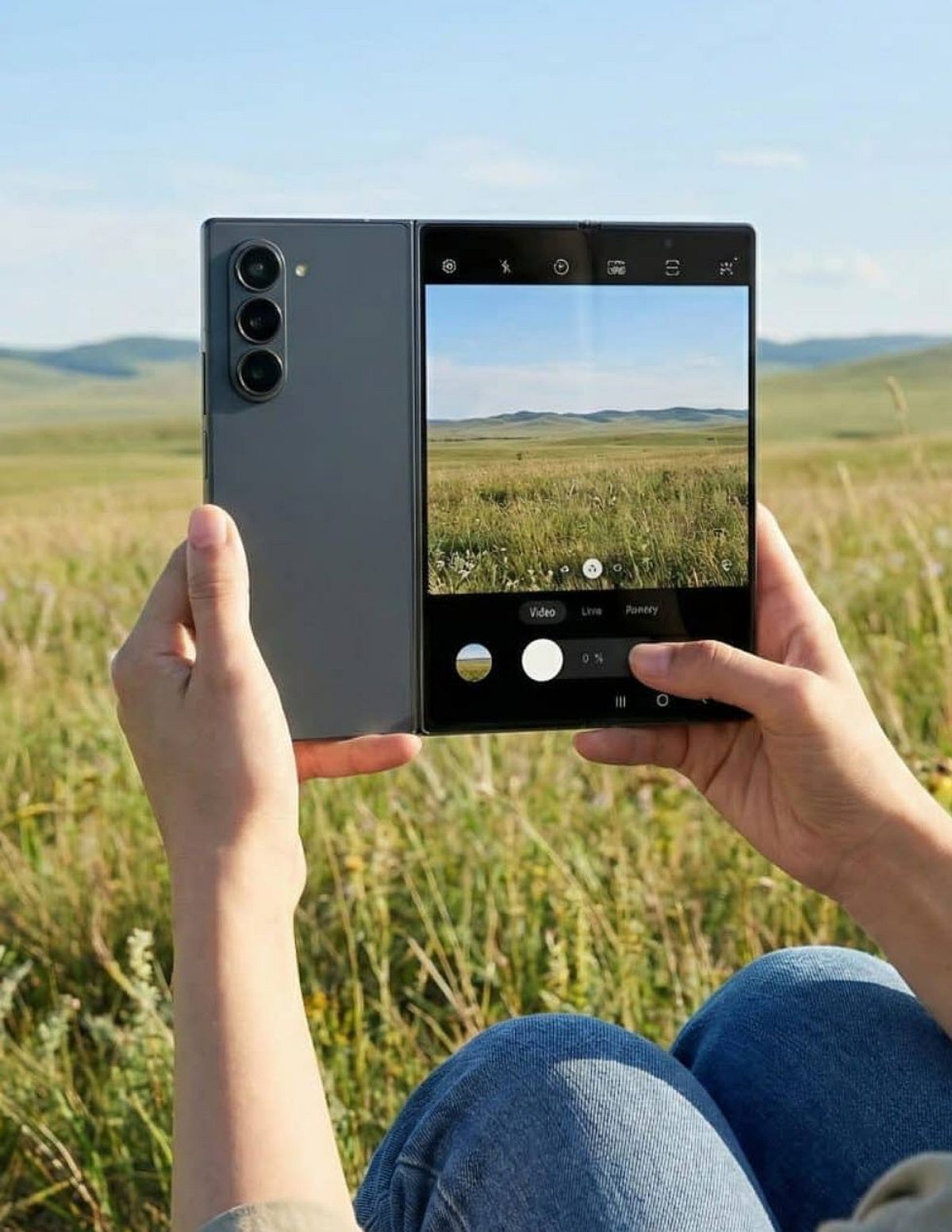
From an industrial design standpoint, this does two things:
- Creates a natural two-hand hold, similar to a compact mirrorless camera.
- Places the camera module on a rigid “anchor panel”, ensuring that only the opposing segments flex, maintaining stability while shooting.
This avoids the structural compromises of placing the camera onto a foldable panel. The “fixed spine” approach is strategic — Samsung is keeping the optics grounded in the firmest part of the device.
New concept renders from Ice Universe envision a future iteration with dual cover screens — one on each exterior panel. Samsung is unlikely to ship this soon, but the industrial thinking behind it is worth dissecting.
Two cover displays would mean:
- Symmetry-driven ergonomics: You can pick up the device in any folded orientation and still have a functional UX surface.
- A reduced need to unfold the phone for casual tasks — messaging, checking notifications, or taking selfies.
- A shift away from a “front/back” identity — the product becomes omnidirectional, closer to a foldable tablet than a phone with a primary front face.
However, this requires flexible displays on both sides — a durability drawback. Exposed plastic OLED surfaces are vulnerable to scratches and punctures. Until ultra-hard flexible glass arrives, Samsung will likely retain one rigid protective cover.
The tri-fold isn’t just another version of the Fold — it’s a different species entirely.
via sammyguru