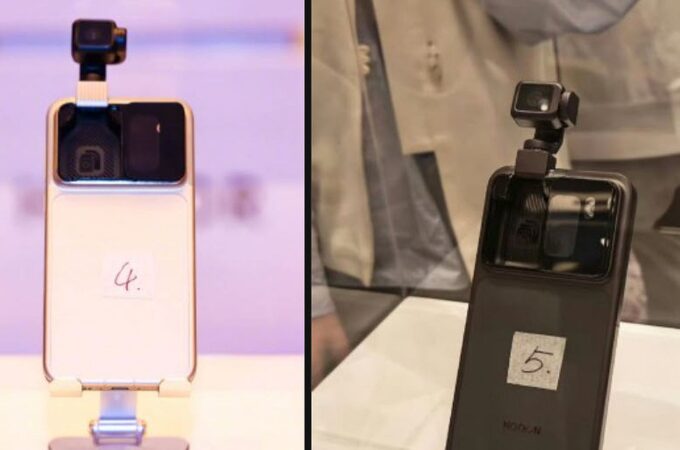
Honor has quietly shown its wildest experiment to date: the Robot Phone, a concept device that fuses smartphone design with robotics, mechatronics, and a camera philosophy borrowed from cinema. Unveiled ahead of its planned MWC 2026 debut, the prototype appeared at the Honor User Carnival in China — in multiple unfinished iterations — giving us a glimpse into a product that looks less like a smartphone and more like a creature built in a design lab.
The most striking design element is, of course, the mechanical gimbal arm. It doesn’t simply pop out — it rises, pivots, and articulates like a miniature periscope. When stowed, it sits flush inside a recessed chamber, concealed beneath a layered, tiered cavity that feels closer to industrial robotics than consumer electronics.

Seen up close, the recess is not decorative. It’s a structural dock: ribbed textures, stepped geometry, and precise cutouts guide the gimbal into place. This is mechanical honesty — the device never tries to hide its moving parts. Instead, it frames them, like exposed joints on a robot.
When in action mode, the arm transforms the phone’s silhouette entirely. The camera becomes an extruding “head,” perched above the body in a way that evokes DJI Osmo Pocket, but integrated as if the device were always meant to be two things at once: a phone and a robot.

Early models feature bold stepped contours around the recessed gimbal chamber, almost brutalist in their geometry. Later iterations smooth these lines, compressing the mechanism and reducing visual noise. Some units feature a dark brushed finish, others a pale metallic sheen, and still others a soft pink tone — each exploring a different material language.

Most phones aspire to invisibility. The Robot Phone does the opposite: it wants to be seen, understood, and even anthropomorphized. Its industrial language leans on cues from robotics labs:
- Exposed mechanics instead of hidden motors
- Angular housings that frame components like joints
- Clear functional segmentation between body, hinge area, and moving arm
- A camera “head” that mimics expressive articulation
It is not difficult to imagine Honor’s designers studying gimbal assemblies, robotic elbows, and cinematic stabilizers to craft this system. Even the squared-off gimbal lens — with its muscular hinge — reads like an eye.
via gsmarena

Recent comments