
While most tech companies chase minimalism, speed, and ergonomic efficiency, Google Japan is off in its own playful dimension — one where nostalgia and absurdity share a desk. Their latest creation, the Gboard Dial Version, looks like a lovechild between a rotary telephone and a typewriter, reimagined through the lens of contemporary industrial design. It’s strange, funny, and oddly beautiful — an object that makes you question the very idea of what a keyboard should be.
At first glance, the Gboard Dial Version appears to be an April Fools’ prank that somehow escaped containment. Instead of the usual rectangular array of keys, you’re greeted by a set of nine circular dials of varying sizes, each styled after the rotary phones of the mid-20th century. The main dial sits proudly in the center, with smaller dials flanking it for functions like arrows, numbers, or modifier keys. Every letter, number, and command must be dialed in — literally. You place your finger into a hole, rotate until it hits a stop, and let go. The movement is slow, deliberate, and comically satisfying.
Unlike the mechanical pulse dialing of vintage telephones, this modern reinterpretation uses embedded sensors to detect rotational input and convert it into digital signals sent over USB. That’s right — this thing actually works. It’s a fully functional keyboard, though you might need a lifetime to finish an email.
But the design team didn’t stop there. Sitting beside the keyboard is an old-school telephone receiver, reimagined as a computer mouse. The attention to detail is stunning — gold accents, coiled white cable, and a cradle that doubles as a smart webcam switch. When you “hang up” the mouse, your camera automatically turns off, echoing the physical gestures of analog devices in a digital age. It’s both satire and sincere design commentary — a tactile response to our increasingly frictionless interfaces.
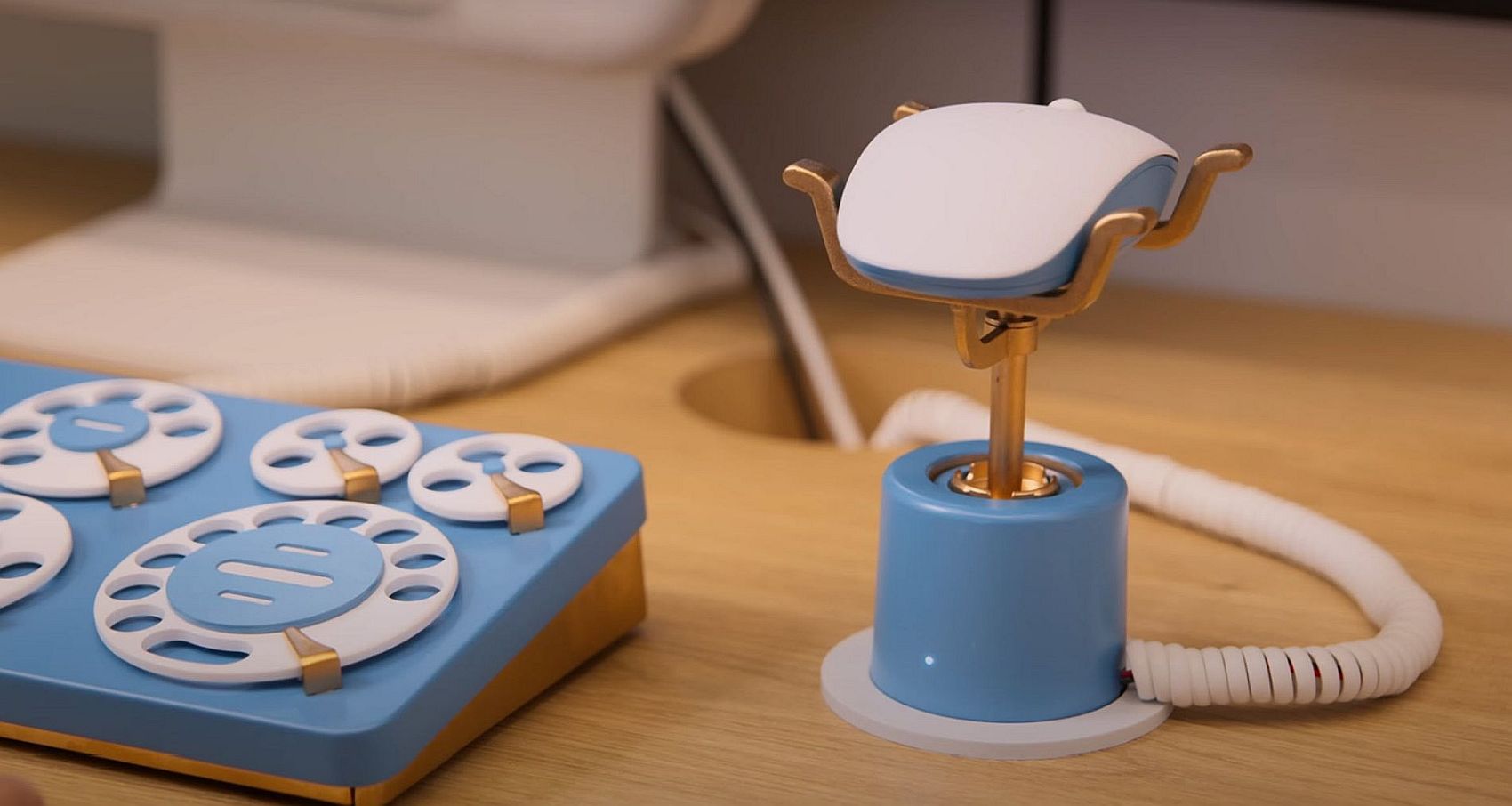
Aesthetically, the Gboard Dial Version walks a fine line between retro-futurism and toy-like absurdity. The cool sky-blue base contrasts with the matte white dials and warm metallic levers, evoking a kind of mid-century optimism that wouldn’t feel out of place in a Wes Anderson film. It’s an object that transforms routine typing into a performative act, reminding us that interaction design can still be joyful, inefficient, and deeply human.
Google Japan isn’t selling this device — and probably never will. But they’ve released the full open-source schematics, from CAD files and PCB layouts to firmware and 3D printing instructions, inviting makers to build their own. It’s a perfect encapsulation of the studio’s design philosophy: equal parts art project, engineering curiosity, and cultural meme.
via stuff.co.za

Recent comments