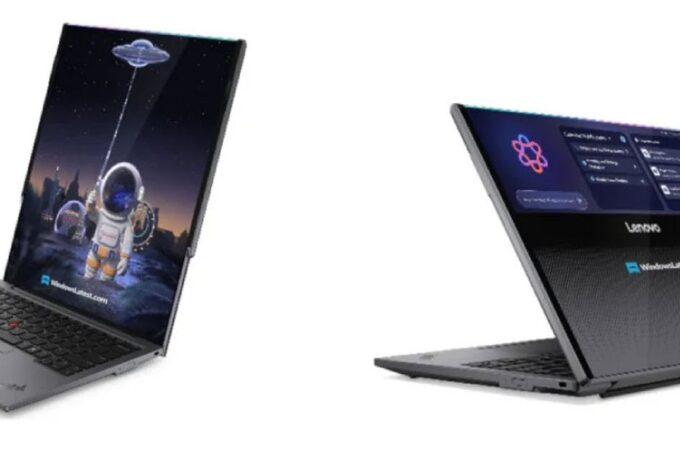
Lenovo is turning rollable displays from a CES curiosity into a recognizable design language. After the ThinkBook Plus Gen 6 Rollable made the jump from concept to a real, shippable product, the company appears ready to push the idea further with what’s reportedly called the ThinkPad Rollable XD Concept, expected to surface at CES 2026. And while the core trick — a screen that physically changes size — remains, the execution is far more daring this time.
At first glance, the Rollable XD looks restrained by ThinkPad standards: a compact 13.3-inch laptop with familiar proportions. But the illusion breaks the moment the display expands vertically into a tall 16-inch workspace. Unlike horizontally expanding designs we’ve seen teased elsewhere, Lenovo’s approach here favors height, turning the laptop into something closer to a vertical canvas — ideal for reading, coding, timelines, or stacked multitasking. It’s less about cinematic width and more about reclaiming vertical real estate that modern laptops have steadily lost.

The real design flex, however, is around the back. Instead of hiding the rolled portion of the OLED panel behind aluminum or plastic, Lenovo is reportedly using a transparent glass rear cover. Through it, you can actually see the flexible display curve and roll when not fully extended. It’s a rare case where a laptop shows its mechanics rather than concealing them, leaning into the visual drama of the technology itself. Lenovo and Corning are said to be collaborating on a 180-degree Gorilla Glass Victus 2 layer to make this feasible, combining durability with clarity.
That transparency isn’t just for show. The exposed portion of the OLED can act as a secondary, outward-facing display, surfacing contextual information like notifications, calendar events, or an AI assistant while the lid is closed. Lenovo reportedly refers to this as a “world-facing display,” positioning the Rollable XD as an early glimpse into its broader vision of contextual, glanceable computing — devices that communicate even when you’re not actively using them.

Design-wise, this makes the Rollable XD feel less like a laptop and more like a dynamic object. It’s a machine that changes posture, presence, and function depending on how and where it’s used. Touch, swipe gestures, and voice controls reportedly play into that flexibility, reinforcing the idea that physical transformation and interface design are meant to work together.
Pricing and specs remain a mystery, and Lenovo is clearly framing this as a concept rather than a near-term product. Still, after shipping a $3,299 rollable laptop in 2025, the idea of a transparent-backed, outward-rolling ThinkPad no longer feels like science fiction. Lenovo isn’t just experimenting anymore — it’s sketching out what a post-static laptop might actually look like.
via windowslatest

Recent comments