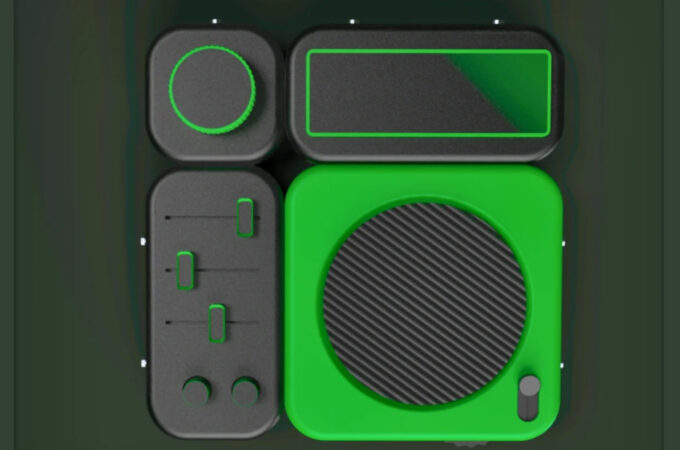
In a world where music is just a swipe away, there’s something poetic about making listening an intentional act again. Enter Spotify Aurora, a modular music player concept imagined by designer Vedant Gugale, that seeks to bring tactility, ritual, and personalization back to the way we experience sound. The visuals shared here (and shown in the concept renderings above) speak volumes—both figuratively and literally.
The Visual Language of Nostalgia Meets Modernity
At first glance, Spotify Aurora evokes a hybrid between a retro synth and a piece of modern furniture. The unit is composed of several chunky, matte-finished modules that magnetically lock together in a grid. A dominant black and green color palette (Spotify’s signature aesthetic) runs through every piece, giving it a cohesive identity. The concept seems to whisper: “This is a device to be seen, touched, and shared.”

The speaker module, with its large, ridged diaphragm and vivid green casing, is the hero of the layout. It’s tactile, deliberate, and reminiscent of old boomboxes or analog radio dials. You can almost hear the bass just by looking at it. But what elevates the design is the ecosystem of supporting modules—each designed for interaction:
- A sliding control module featuring three faders and rotary knobs—ideal for volume, EQ, or playlist control.
- A circular rotary dial that adds an old-school physical twist to menu navigation or volume adjustment.
- A display strip, likely for song or artist info, glowing with minimal green highlights.
- And importantly, a port for RFID album chips, the real heart of the experience.

RFID Chips: The Future’s Cassette
Spotify Aurora proposes a bold throwback: reintroducing music as a physical medium through RFID-enabled chips. These tiny collectibles act as modern equivalents to mixtapes, LPs, or CDs. Just tap the chip to the device and your playlist or album begins—instantly. No menus, no distractions.
In this world, a playlist becomes a tangible artifact. Share it with a friend, gift it, or curate a collection like we did with records. It’s not only about what you’re listening to—it’s about how it’s given, displayed, and remembered.
Modularity as Self-Expression
Perhaps the most exciting aspect of Aurora is its modularity. Users can configure their own setup depending on context. A solo listener might only need the speaker, screen, and RFID reader. Hosting a party? Add more speaker units or light modules that pulse to the rhythm.
The plug-and-play nature of these blocks invites personalization, not just in function, but in form factor and mood. From a design standpoint, it’s a masterclass in UI/UX meeting tactile industrial design. Each module appears secured with visible screws—reminding us of old tech—yet the curves and seamless joins show a futuristic polish.
Even the ports are thoughtfully placed, as seen in the bottom edge of the green speaker module: USB-C charging, control toggles, and perhaps even audio I/O for modular daisy-chaining.
Design That Invites Interaction
Unlike the cold glass of a smartphone screen, Spotify Aurora wants you to reach out and touch your music. The haptic click of joining modules, the turn of a dial, or the satisfying slide of a fader makes the act of listening visceral again.
It repositions music as a shared physical experience, not just a private headphone moment. Imagine inviting someone over and handing them your favorite album—literally. It turns streaming into something ceremonial.
Final Thoughts
While Spotify Aurora remains a concept for now, it raises critical questions about the role of design in shaping our digital habits. It challenges us to reintroduce tactility, presence, and joy to music consumption in an age where everything is ephemeral.
By combining RFID magic, modular design, and Spotify’s identity, Vedant Gugale’s vision proves that innovation doesn’t always mean screen-deep. Sometimes, the future lies in reminding us how things used to feel—and making them better.
via Yanko Design

Recent comments